
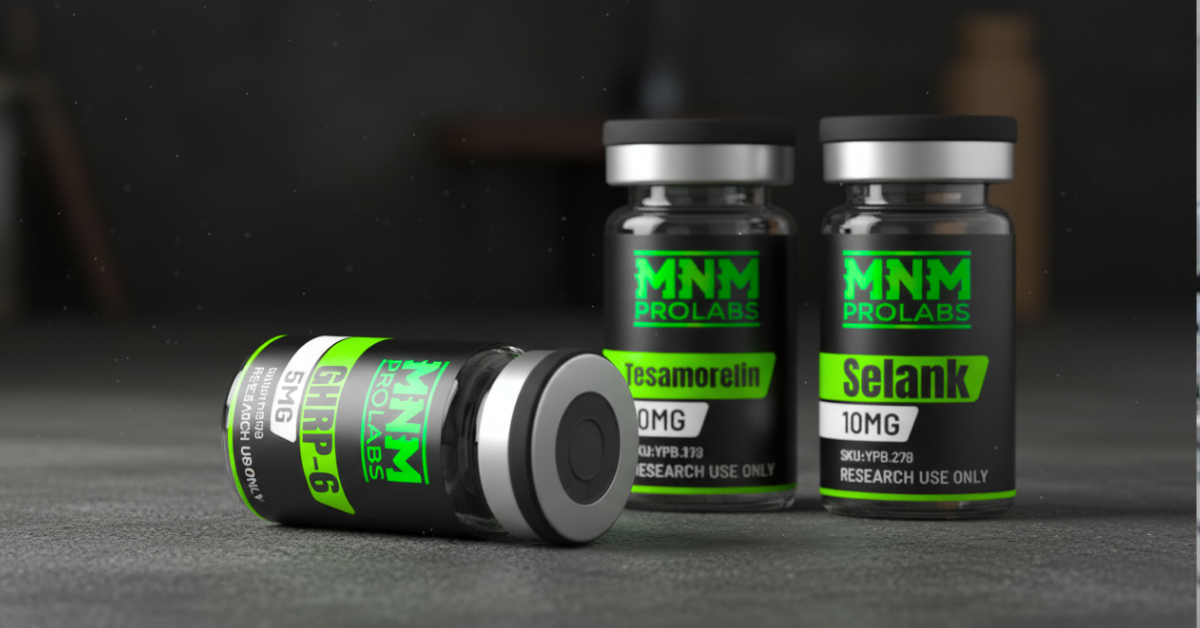
Peptides have moved from “interesting biomolecules” to core tools across drug discovery, diagnostics, delivery science, and biomedical method development. In 2026, the headline is not just “more peptides,” but better peptide engineering: improved design, more realistic predictive modeling, stronger delivery concepts, and accelerating work in targeted conjugates and macrocyclic formats.
At the same time, the field is also confronting a hard truth: peptide results are only as trustworthy as the inputs—meaning identity, purity/impurity profiles, stability, handling, documentation, and traceability. That’s exactly why research teams increasingly evaluate peptide suppliers as part of their data integrity strategy—not just procurement.
This is where MNM ProLabs’ Medical Research Department differentiates itself: it publicly describes a separate research division with its own SOPs, QA/QC, and research-only labeling discipline, purpose-built for controlled non-clinical workflows.
1) The 2026 Research Frontier: AI-Driven Peptide Design Becomes Practical
One of the most important 2026 developments is that generative AI is no longer just a concept demo for peptides—it is increasingly described as a practical layer in the design loop: proposing sequences, anticipating structure–function relationships, and supporting screening and optimization strategies.
A 2026 open-access review in Chemical Communications highlights how deep learning architectures (including transformers and diffusion-style approaches) are being used for sequence generation, interaction modeling, and delivery optimization, while also emphasizing persistent bottlenecks like data quality, solubility prediction, and toxicity/immunogenicity risk.
Complementing that, 2025–2026 reviews emphasize the rising maturity of the computational pipeline for peptides—representation methods, similarity tools, predictive ML/DL models, and design toolkits meant to make peptide discovery workflows more accessible and reproducible.
Why this matters to real labs
AI acceleration only helps if experimental confirmation is clean. That pushes more labs to demand:
-
Lot-specific documentation
-
Verifiable analytical methods
-
Reliable shipping/handling controls
-
Consistent formatting and labeling for RUO work
Those points align closely with MNM ProLabs’ public positioning: standardized product formatting, disciplined compliance boundaries, and a system designed around repeatability and documentation.
2) The Delivery Problem in 2026: Oral Peptides and Membrane Transport Get More Mechanistic
Peptide delivery remains one of the biggest scientific constraints. Many peptides are potent and selective, but struggle with oral absorption, enzymatic degradation, and membrane permeability.
A notable 2025 Nature Communications paper examined how permeation enhancers can induce membrane defects that help explain oral absorption mechanisms for peptide drugs, tying this to successful oral peptide formulations (and discussing peptide permeation as a distinct challenge compared with small molecules).
This line of research is important because it’s not just “try an enhancer,” but “understand the membrane-level mechanism,” which is crucial for rational formulation and translational safety thinking.
Why this matters to RUO peptide work
Even in non-clinical settings, delivery research depends on consistent material quality and stable reconstitution behavior. If your peptide’s impurity profile or handling conditions vary, your delivery conclusions can become noise.
That’s why supplier signals like COA availability, consistent packaging, and documented handling expectations matter—not as marketing, but as experimental controls. MNM ProLabs’ RUO program explicitly emphasizes third-party testing and COAs, and describes cold-chain/logistics discipline as part of integrity.
3) Oncology Momentum: Peptide–Drug Conjugates (PDCs) and Targeting Strategies Expand
In 2026, peptide–drug conjugates continue gaining attention as a targeted delivery strategy—often framed as offering advantages in size, penetration, and design flexibility compared with larger biologics in certain contexts.
A 2026 review in Chinese Medical Journal discusses design concepts in tumor-targeting peptide–drug conjugates, describing PDCs as a strategy aimed at improving efficacy while reducing toxicity through targeting and formulation choices.
Additional 2025–2026 reviews discuss the key engineering elements: peptide targeting moieties, linkers, payloads, stability, and uptake mechanisms.
The RUO implication
PDC and targeting research is extremely sensitive to:
-
Peptide identity
-
Batch-to-batch consistency
-
Analytical characterization
-
Clean traceability of sequence and modifications
This is where the supplier’s documentation discipline becomes part of the science.
4) The Hidden Variable in 2026: Reproducibility Depends on Inputs, Not Just Methods
By 2026, peptide science is sophisticated—but the operational reality is simple: you can run a perfect assay with an imperfect peptide and still generate misleading results.
Reproducibility problems in peptide workflows most often trace back to:
-
Unclear or missing COAs
-
Weak lot traceability
-
Inconsistent storage/shipping
-
Ambiguous labeling and claims that blur RUO boundaries
-
Variable solubility behavior tied to impurities or mishandling
MNM ProLabs’ Medical Research Department repeatedly frames its differentiation around solving exactly those friction points: a “system,” not just product—emphasizing consistency, clarity, documentation & traceability, and a culture of quality discipline.
What Sets MNM ProLabs Medical Research Department Apart
Below is a structured, evidence-based set of differentiators drawn from MNM’s publicly available program descriptions and policies.
1) True division separation between consumer and research programs
MNM states its Medical Research Department is a distinct division from its consumer supplement business, with separate SOPs and compliance documentation, and explicit research-only labeling discipline.
That separation matters because it reduces risk of:
-
Confusing claims
-
Cross-channel messaging that undermines RUO integrity
-
Compliance ambiguity that can create institutional procurement issues
2) Documentation-first culture: SOPs, QA/QC systems, RUO compliance language
MNM describes a workflow anchored in SOPs, QA/QC, audit readiness, and RUO-specific labeling controls—positioning “clarity as compliance.”
3) Third-party analytical testing + Certificates of Analysis (COAs)
MNM’s “About” and FAQ content explicitly states products are backed by third-party analytical testing and COAs (with COAs available by account download or request).
4) Controlled handling awareness and cold-chain logistics emphasis
In its program materials, MNM highlights disciplined cold-chain and chain-of-custody practices as part of research integrity—not an afterthought.
5) A research-facing commitment to standardization
MNM explicitly frames its value as reducing the need for labs to “re-learn” a supplier’s quality with every order by focusing on consistent formatting, bounded language, and repeatable processes.
Why MNM ProLabs Should Be Your Go-To for Research Peptides
If your lab values repeatability, traceability, and defensible data integrity, MNM ProLabs’ Medical Research Department is positioned (by its own published standards) as a supplier built for researchers who want:
-
Clear RUO boundaries (no clinical/therapeutic positioning)
-
Lot-specific documentation and COA access
-
Quality systems described in SOP/QA language rather than vague marketing
-
A supply chain that treats shipping/handling as part of integrity
In other words: in 2026 peptide science, precision isn’t only what happens at the bench—it’s built upstream, starting with how peptides are verified, documented, packaged, and communicated. MNM ProLabs explicitly markets itself around that “upstream integrity” model.
Practical Checklist: What Smart Labs Look For in 2026 (and where MNM aligns)
If you’re comparing peptide suppliers, this 2026 checklist helps you separate “claims” from “systems”:
-
COA availability (per-lot, accessible, consistent)
-
Third-party analytical verification (not just “internal testing”)
-
Clear RUO compliance language (no dosing, no medical guidance, no therapeutic promises)
-
Traceability and documentation discipline (lot IDs, test dates, SOP language)
-
Shipping and handling controls (especially for sensitive materials)
-
Standardized product formatting (reduces operational noise across orders)
MNM ProLabs’ Medical Research Department explicitly positions itself as strong on each of these points in its published program materials.
Compliance Reminder
Peptide research is advancing fast, but responsible sourcing and communication is non-negotiable. MNM’s own policy language emphasizes Research Use Only, not for human consumption, and no diagnostic/therapeutic intent.
References (2025–2026 and MNM program sources)
-
Ekambaram S., Dokholyan N.V. “Peptide-based drug design using generative AI.” Chemical Communications (2026).
-
Colston K.J. et al. “Permeation enhancer-induced membrane defects assist the oral absorption of peptide drugs.” Nature Communications (2025).
-
Tan R. et al. “Innovative design concepts in tumor-targeting peptide-drug conjugates.” Chinese Medical Journal (2026).
-
Parang K. et al. “Tumor Targeting with Peptide-Drug Conjugates.” Drug Design, Development and Therapy (2026).
-
Erckes V. (PubMed review record) “Computational approaches in peptide research… peptide cheminformatics tools…” (2025/2026 record).
-
MNM Peptides — “About Us” (Medical Research Department overview; third-party testing and COAs).
-
MNM Peptides — FAQ (COA availability statements).
-
MNM Peptides — “Medical Research Department Announces Official Peptide Program Launch” (120+ portfolio; division separation; RUO compliance framing).
-
MNM Peptides — “The MNM PROLABS Medical Research Department” (division structure; SOP/QMS framing; RUO-only compliance language).
-
MNM Peptides — “Why Medical Research Professionals Choose MNM ProLabs Peptides” (consistency/clarity/traceability/quality discipline; cold-chain emphasis).